


The 2027 Best Law Firms™ – Canada rankings recognize 1,325 firms for their work across a wide range of legal disciplines and markets nationwide. Now in its third edition, the research highlights firms that demonstrate strength in their respective areas of practice.
The results span 68 regional and 34 national practice areas, reflecting the breadth of legal services represented across Canada. They also offer insight into how firms are approaching client relationships, pricing and emerging technologies as expectations surrounding legal services continue to evolve.
The awards mark an opportunity to celebrate these firms and their contributions to Canada’s legal profession.
Researching Canada’s Leading Law Firms
Thousands of participants contributed to the research informing this edition of Best Law Firms – Canada. Led by Best Lawyers®, the Best Law Firms methodology combines feedback from the legal community with an evaluation of firms and individual practice groups to provide a detailed picture of legal capabilities across the country.
For this edition, 8,274 lawyers and 1,360 firms were surveyed, 4,631 client references were received and 354 practice group interviews were conducted.
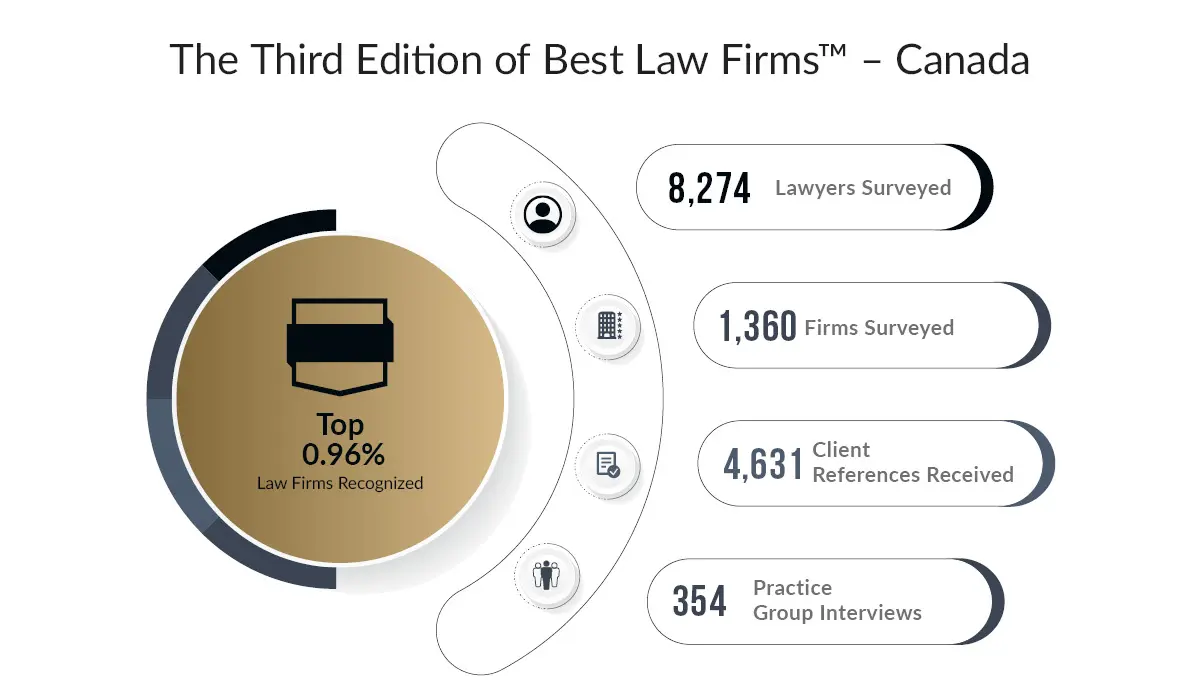
That breadth of participation also provides insight into how the Canadian legal market is changing. As Valerie Smith, Senior Research Manager at Best Law Firms, explains, “The depth of this research gives us a valuable view into the Canadian legal market, from the focused expertise of specialized boutiques to the broad reach of regional and national firms.”
To explore how firms are researched and evaluated, visit the Best Law Firms – Canada methodology page.
Three Levels of Distinction Across Canada
Best Law Firms – Canada recognizes firms at regional and national levels, with select firms also receiving a “Law Firm of the Year” honor. Each distinction reflects a different level of recognition within the Canadian legal market.
- Regional: 1,325 firms across 68 practice areas, representing the top 2.5% of the market.
- National: 502 firms across 34 practice areas, placing them among the top 0.96%.
- “Law Firm of the Year”: 27 firms across 34 practice areas, representing the top 0.052%.
Canada’s “Law Firm of the Year” Honorees
The “Law Firm of the Year” awards are the highest honors in Best Law Firms – Canada, recognizing one firm in each practice area for outstanding performance. The 2027 recipients are:
- JFK Law LLP — Aboriginal Law / Indigenous Practice
- Lenczner Slaght — Administrative and Public Law; Corporate and Commercial Litigation
- Cassels Brock & Blackwell LLP — Advertising and Marketing Law
- Fasken — Alternative Dispute Resolution; Mining Law
- Paliare Roland Rosenberg Rothstein LLP — Appellate Practice
- Norton Rose Fulbright Canada LLP — Banking and Finance Law; Competition / Antitrust Law
- McCarthy Tétrault LLP — Biotechnology and Life Sciences Practice; Privacy and Data Security Law
- Siskinds LLP — Class Action Litigation
- Singleton Urquhart Reynolds Vogel LLP — Construction Law
- Stikeman Elliott LLP — Corporate Law; Leveraged Buyouts and Private Equity Law
- Peck and Company — Criminal Defence
- Borden Ladner Gervais LLP — Energy Law
- Michael, Evrensel & Pawar LLP — Entertainment Law
- Blake, Cassels & Graydon LLP — Environmental Law; Insolvency and Financial Restructuring Law
- Epstein Cole LLP — Family Law
- Corporate Immigration Law Firm — Immigration Law
- Clyde & Co LLP — Insurance Law
- Goodmans LLP — Intellectual Property Law
- Goldblatt Partners LLP — Labour and Employment Law
- Lerners — Medical Negligence
- Torys LLP — Mergers and Acquisitions Law; Securities Law
- Bennett Jones LLP — Natural Resources Law
- Gluckstein Personal Injury Lawyers — Personal Injury Litigation
- Miller Thomson LLP — Real Estate Law
- KPMG Law LLP — Tax Law
- WeirFoulds LLP — Trusts and Estates
- Hicks Morley Hamilton Stewart Storie LLP — Workers' Compensation Law
Canada’s Leading Firms by National Tier 1 Rankings
The following firms earned the highest number of National Tier 1 rankings. The list reflects the 10 highest totals, with firms sharing a position when they received the same number of National Tier 1 rankings:
- Fasken; Borden Ladner Gervais LLP — 30
- Gowling WLG — 29
- Norton Rose Fulbright Canada LLP; McCarthy Tétrault LLP; Osler, Hoskin & Harcourt LLP — 28
- Blake, Cassels & Graydon LLP; Stikeman Elliott LLP — 26
- Dentons Canada LLP — 25
- Davies Ward Phillips & Vineberg LLP — 22
- DLA Piper (Canada) LLP; Torys LLP — 21
- McMillan LLP; Bennett Jones LLP — 20
- Lawson Lundell LLP — 19
- Miller Thomson LLP — 18
Where Canadian Law Firms Are Most Widely Recognized
The Best Law Firms – Canada results highlight the practice areas with the greatest representation at the national level. Based on the number of firms ranked in each area, the top five positions are:
- Corporate and Commercial Litigation
- Personal Injury Litigation
- Labour and Employment Law
- Insurance Law and Family Law
- Real Estate Law and Trusts and Estates
Looking back at the 2026 Best Law Firms – Canada results, the same five practice areas remain among the leaders. Corporate and Commercial Litigation, Personal Injury Litigation and Labour and Employment Law retain the top three positions, while Insurance Law and Real Estate Law join the group through ties with Family Law and Trusts and Estates, respectively.
A comparison with The Best Lawyers in Canada™ 2027 shows further overlap. Corporate and Commercial Litigation leads both, while Labour and Employment Law and Real Estate Law also appear among the top five.
From Courtroom Evidence to Care-First Insurance
Recent court decisions, regulatory changes and legislative reforms are influencing several of the practice areas most widely represented in the Best Law Firms – Canada results.
Corporate and Commercial Litigation Faces New Guidance on Evidence
A 2026 Supreme Court of Canada decision clarified the consequences when relevant evidence is intentionally destroyed, altered, hidden or not preserved during litigation. In SS&C Technologies Canada Corp. v. Bank of New York Mellon Corp., the Court held that once a spoliation is established, courts must presume the missing evidence would have been unfavorable to the responsible party. Courts retain discretion in determining the appropriate remedy.
The Supreme Court ruling provides new guidance for disputes involving evidence preservation and the remedies available when relevant material is lost or destroyed.
Personal Injury and Insurance Prepare for Alberta’s Care-First Model
Alberta is preparing for a significant change to automobile injury claims with its Care-First auto insurance system, scheduled to take effect Jan. 1, 2027. The model expands access to treatment, income replacement and other benefits while restricting the ability to sue an at-fault driver in most circumstances.
The new framework affects both personal injury and insurance practice as Alberta shifts more collision-related compensation away from litigation and toward an insurance-based benefits system.
Employment Rules Add New Requirements for Hiring
Ontario introduced new requirements for publicly advertised job postings on Jan. 1, 2026. Under the province's Employment Standards Act requirements, covered employers must include expected compensation or a compensation range, disclose whether artificial intelligence is used to screen, assess or select applicants and state whether an actual vacancy exists. Canadian-experience requirements are also prohibited in covered job postings and associated application forms.
The framework adds compliance considerations as hiring practices, pay transparency and the use of AI increasingly intersect with employment law.
A New Federal Rebate Changes the Equation for First-Time Home Buyers
Canada introduced a new GST/HST rebate for eligible first-time home buyers purchasing, building or substantially renovating a new home. The rebate can recover up to 100% of the GST or federal portion of the HST on qualifying homes valued at $1 million or less, up to a maximum of $50,000, with a reduced rebate available on homes between $1 million and $1.5 million.
The measure introduces another tax consideration for eligible buyers, builders and advisers involved in residential real estate transactions.
Trust Reporting Rules Enter a New Phase
Federal trust reporting requirements changed after Bill C-15 received royal assent in March 2026. Under the updated Canada Revenue Agency rules, bare trusts are not required to file a T3 return for taxation years ending in 2025, while certain bare trusts will become subject to reporting requirements for taxation years ending on or after Dec. 31, 2026.
The amendments also change filing exemptions for certain other trusts, giving trustees and advisers another reason to review reporting obligations as the revised framework takes effect.
What Canadian Law Firms Are Prioritizing
The Best Law Firms – Canada 2027 survey results offer a closer look at how Canadian law firms are approaching growth, client service and changes in the delivery of legal work. Responses from firms ranging from solo practices to large firms, point to three themes: the continued importance of relationships, greater flexibility and transparency around fees and the developing role of generative AI.
1. Relationships Remain Central to Firm Growth
Relationships continue to play a significant role in how Canadian firms attract and retain business. Among firms that answered the marketing channel question, 96% use word of mouth to reach potential clients. Nearly three in 10 firms answering a separate retention question said repeat clients and referrals accounted for more than 75% of new work.
Yet formal approaches to gathering client feedback are far less common. Only 16% of firms answering the question conduct client feedback surveys regularly, even as 82% identify client feedback and service improvement as a priority for differentiation.
As Elizabeth Petit, SVP of Research & Product Strategy at Best Lawyers, explains, “The Canada data shows just how central relationships are to law firm growth. When more than half of responding firms receive at least half of their new work from returning clients or referrals, client experience is not separate from business development, it is one of its strongest foundations.”
2. Flexible Fees Meet Greater Billing Transparency
Canadian firms are also giving clients more options in how legal services are priced. Of the firms answering the alternative billing question, 74% offer at least one alternative arrangement. Flat fees were the most common option among firms that provided details, followed by retainers, fixed fees and other arrangements designed to provide greater flexibility.
Clearer communication around costs accompanies that shift. Survey responses show that 94% of firms provide detailed line-item invoices, while 86% share upfront cost estimates and 68% provide regular budget updates during engagements.
As Smith observes, “The transparency findings are especially encouraging. Detailed invoices and upfront estimates are now standard practices among responding firms and regular budget updates are also common. Those practices help set expectations early and may be one reason billing disputes remain relatively limited.”
3. GenAI Begins to Influence How Legal Work Is Billed
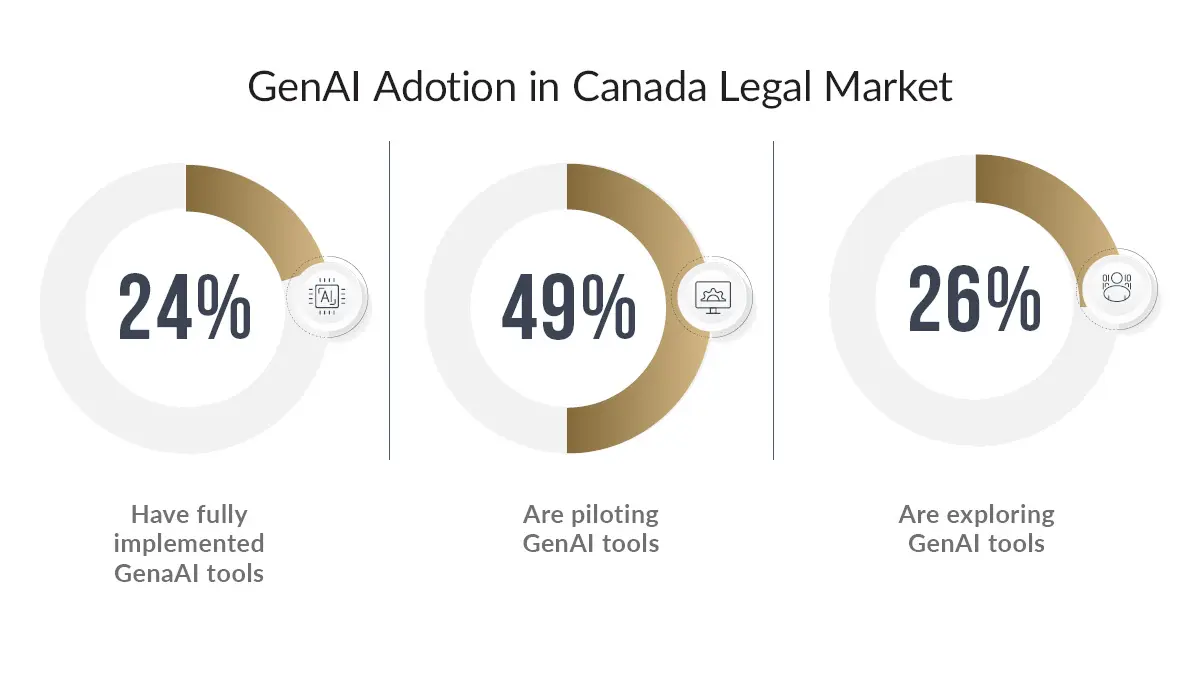
Generative AI remains at varying stages of adoption among Canadian firms. Of respondents, 49% said firms are piloting GenAI tools, 26% are exploring adoption and 24% report full implementation across multiple practice areas. Legal research emerged as the most common current or planned use.
Early effects are also appearing in billing. Among GenAI-using firms that answered the billing question, 34% reported reduced billable hours for certain tasks, while 31% saw increased efficiency without changing billable hours.
Firms are also developing internal safeguards around the technology, with 68% of those answering the relevant question providing lawyer training and 59% establishing policies for its use in client matters.
As Petit notes, “The Canadian market is still largely in the testing phase, but the billing data shows that GenAI is already affecting how some legal work is delivered. The next challenge will be turning experimentation into consistent practices around quality, pricing and client expectations.”
For additional insight into the trends shaping the profession, explore the Best Law Firms – Canada Legal Market Report.
A Broader View of Canada’s Legal Market
The Best Law Firms – Canada results provide more than a way to identify leading firms. They illustrate the range of legal capabilities available across the country, from firms with a national presence to those distinguished by focused expertise in particular practices and markets. Together, the results provide clients, businesses and legal professionals with an independent resource for navigating the Canadian legal market.
Congratulations to all firms honored in the 2027 edition and to the professionals whose work contributed to their recognition.
Explore the 2027 Best Law Firms – Canada rankings to find recognized firms across practice areas and regions.