
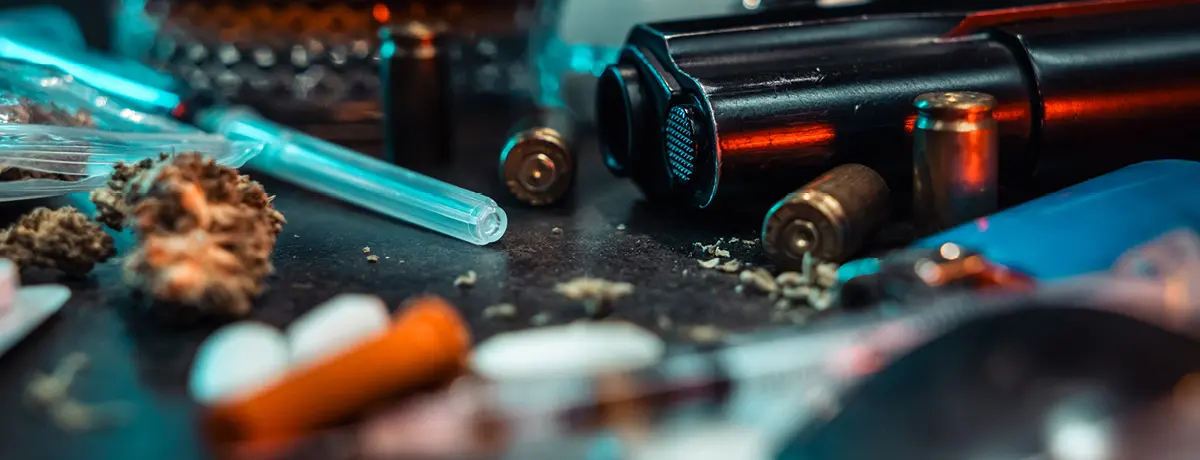

In a case that sits at the explosive intersection of gun rights, drug statutes, and constitutional law, the U.S. Supreme Court will soon decide whether the Second Amendment trumps a federal ban that prohibits drug users from possessing firearms.
The case, U.S. v. Hemani, defies typical conservative and liberal divisions, with gun control advocates siding with the Trump administration and a coalition that includes the American Civil Liberties Union and National Rifle Association teaming to oppose the government.
It also exposes fault lines in the Trump administration’s stances on gun rights and marijuana use, with the U.S. Department of Justice taking a hardline stance at a moment when the administration appears poised to reclassify marijuana from its current federal status as one of the most dangerous drugs.
The Hemani case may also give justices an opportunity to refine 2022’s landmark New York State Rifle and Pistol Association v. Bruen. The decision created a new test, heightening constitutional scrutiny of firearm-related regulations—and has also led to confusion among lower court judges who have struggled to interpret the court’s reasoning.
U.S. v. Hemani: Case at a Glance
- Issue: Does the Second Amendment protect the gun rights of unlawful drug users?
- Law at stake: Gun Control Act of 1968, 18 U.S.C. § 922(g)(3)
- Key precedent: N.Y. State Rifle & Pistol Ass'n v. Bruen (2022)
- Unusual alliance: ACLU and NRA both oppose the government's position
- Oral arguments: March 2, 2026; decision expected by June 2026
- Wild card: Trump administration is simultaneously moving to reclassify marijuana as Schedule III
The Historical Tradition Test: How Bruen Changed Second Amendment Analysis
The Hemani case hinges on the court’s interpretation of a section of the Gun Control Act of 1968, a statute enacted in the wake of the assassinations of Martin Luther King, Jr. and Robert F. Kennedy and amended in the 1980s. The law prohibits gun possession by several categories of individuals, including anyone who is deemed “an unlawful user of or addicted to any controlled substance.”
In February 2023, a grand jury in the Eastern District of Texas charged Ali Hemani with possessing a firearm as an unlawful drug user. Ali’s lawyers argued that the statute violated the Second Amendment, particularly in the wake of the Supreme Court’s decision in Bruen.
The Bruen decision established that firearm regulation must be consistent with the nation’s “historical tradition,” and only then may a court conclude that an individual’s conduct falls outside the Second Amendment.
“When the Second Amendment’s plain text covers an individual’s conduct, the Constitution presumptively protects that conduct,” Justice Clarence Thomas wrote in his majority opinion in Bruen. “To justify its regulation, the government may not simply posit that the regulation promotes an important interest. Rather, the government must demonstrate that the regulation is consistent with this Nation’s historical tradition of firearm regulation.”
Founding-Era Analogues: Habitual Drunkards and the Gun Control Act of 1968
A magistrate judge recommended granting Hemani’s motion to dismiss the indictment, agreeing that the government had not adequately identified “historical analogues” for the 1968 law. The U.S. Court of Appeals for the Fifth Circuit agreed that the law was unconstitutional as applied to Hemani.
The government argues that the drug-user ban “fits comfortably within this nation’s tradition of firearm regulation.” In particular, founding-era legislatures restricted the rights of “habitual drunkards” subjecting them to “imprisonment in workhouses or confinement in asylums,” the government said in its reply to Hemani’s Supreme Court brief.
While Hemani’s lawyers argue that those laws do not specifically prohibit firearm possession, the government cited the Supreme Court’s 2024 decision in U.S. v. Rahimi, which held that if the nation’s founders imprisoned individuals for the habitual use of intoxicating substances, then “the lesser restriction of temporary disarmament…is also permissible.”
Government lawyers also said founding-era surety laws were a relevant analogue to the 1968 statute because they allowed magistrates to demand bond from individuals found to pose a specific threat, including from “common drunkards.”
What Counts as a Habitual Drug User Under Federal Gun Law?
The charges against Hemani stem from an FBI raid of his home in Denton County, Texas. Citing court documents, Reuters reported that during the raid, agents found a Glock 9mm pistol, as well as marijuana and cocaine. Hemani told agents that he used marijuana “about every other day, though authorities did not accuse him of being intoxicated at the time of the search,” Reuters said.
The government has characterized Hemani’s drug use as habitual—and has drawn parallels to the habitual drunkards targeted in founding-era laws. At oral arguments on March 2, Sarah Harris, a Justice Department lawyer, told the Supreme Court that the historic restrictions on “habitual drunkards” are similar to the Gun Control Act’s ban because they “reflect public safety concerns about the dangers of frequently using intoxicants.”
Upholding the law, Harris also argued, “would not open the door to disarming weekend beer drinkers.” Unlike alcohol, she said, “illegal drugs are illegal. They're illegal because Congress deemed their use dangerous at any level, and their dangers extend beyond their mind-altering effects to the risks of illegal drug trade.”
Supreme Court Justices Question Whether Drug Use Makes Gun Owners Dangerous
A number of justices appeared skeptical of the government’s argument and appeared concerned that the Gun Control Act’s ban was overly broad. They closely questioned Harris about what constituted habitual behavior, which drugs would trigger a ban, and what constituted a danger to the public.
“Is it the government's position that if I unlawfully use Ambien or I unlawfully use Xanax, then I become dangerous?” Justice Amy Coney Barrett asked. “[W]hat is the government's evidence that using marijuana a couple times a week makes someone dangerous?”
Justice Neil Gorsuch probed whether the government’s standards for dangerous behavior matched those of the founding era. “John Adams took a tankard of hard cider with his breakfast every day. James Madison reportedly drank a pint of whiskey every day. Thomas Jefferson said he wasn't much of a user of alcohol, he only had three or four glasses of wine a night,” Gorsuch said. “Are they all habitual drunkards who would be properly disarmed for life under your theory?”
Gorsuch contrasted the founding fathers with a modern individual who might be disarmed for taking "one gummy bear every other night with a medical prescription.”
Gorsuch also asked whether the DOJ would prosecute users of any drug listed on the government’s schedules of dangerous drugs. Marijuana is listed among Schedule I drugs, which are the most dangerous, according to federal regulations. “Your primary position is, if it's scheduled in any way, so long as you use it a couple of times a week, you're subject to disarmament?” Gorsuch asked. Martin replied, “That is our position.”
‘An Absolute Hash': The Risk of Overturning the Drug-User Gun Ban
Hemani’s backers see the government’s position as an invitation for federal law enforcement officials to use the Gun Control Act as a cudgel against criminal defendants and to threaten the rights of scores of legitimate firearm owners.
The Gun Control Act’s ban “operates not as a bulwark against dangerous individuals who are at special risk of misusing firearms, but as a mechanism for selective prosecution and as a leverage tool deployed when other charges cannot be sustained,” said an amicus brief filed by the National Association of Criminal Defense Lawyers (NACDL).
If the court upholds the government’s position, “the scale of potential disarmament…is staggering considering that millions of gun-owning Americans report some degree of regular marijuana use. And the statute could sweep further still, reaching anyone who has used ‘any controlled substance,’ without providing fair notice of when such use crosses into ‘unlawful user’ status,” the NACDL added.
Chief Justice John Roberts, on the other hand, worried that Hemani’s lawyers were placing too much of the burden on lower court judges to make individual decisions about the drugs listed as controlled substances by the federal government. “It just seems to me that takes a fairly cavalier approach to the necessary consideration of expertise and the judgments we leave to Congress and the executive branch,” Roberts said.
“I think the questions just cascade from there,” Harris said in reply. Overturning the ban would “make an absolute hash” of the current law, she said, noting previous writings by Justice Samuel Alito that called the statute a cornerstone of violence prevention.
Three Key Legal Areas to Watch After the Supreme Court's Hemani Ruling
Whatever the Supreme Court rules, lower courts, prosecutors, and criminal defense specialists will feel Hemani’s ripple effects. Here are three key areas to watch:
1. Greater Clarity for Lower Courts? Will justices use Hemani to provide greater clarity about the historical precedents courts should follow when considering gun rights laws? As Scotusblog recently noted, the court’s 2022 decision in Bruen “unleashed challenges to every type of gun regulation.” Gun rights advocates have filed hundreds of challenges to state and federal laws. “Predictably, the lower courts have struggled with the myriad of gun issues in terms of applying the court’s historical approach,” Scotusblog wrote. “As [Justice Ketanji Brown] Jackson observed about the post-Bruen landscape, these courts ‘have come to conflicting conclusions on virtually every consequential Second Amendment issue to come before them.’”
2. Or Muddier Legal Waters? While Hemani has the potential to give courts and lawyers clearer direction about the historical standards that they should follow, the justices may also issue a decision that further muddies the waters. The court could emerge with a split decision that gives marijuana users additional rights but maintains Gun Control Act restrictions for other drugs. As Vox reported, Justice Elena Kagan directly proposed “a framework that would allow marijuana users like Hemani to keep their guns but would still allow the government to disarm people who use very dangerous drugs.”
3. Marijuana Rescheduling and Federal Gun Law. Will the Hemani case affect Trump administration marijuana policy? The DOJ’s stance in the Hemani case appears at odds with recent moves by the Trump administration around marijuana. In January, the Bureau of Alcohol, Tobacco, Firearms, and Explosives (ATF) moved to blunt Hemani’s potential impact by redefining what it means to be an unlawful user of a controlled substance when determining whether an individual should be disarmed.
That move follows a December executive order from President Trump directing the Drug Enforcement Administration define marijuana as a less-dangerous Schedule III drug. As Gorsuch noted, “The drug that is involved in this case might wind up being a Schedule III drug tomorrow. It’s just an odd case to have chosen to test the principle when the government itself is potentially rescheduling it as a drug.”
Also worth noting: The court’s decision may signal how it will handle federal statutory penalties for behavior that is legal under state laws. While still prohibited at the federal level, marijuana use is legal in 40 states.
---
David L. Brown is a legal affairs writer and consultant, who has served as head of editorial at ALM Media, editor-in-chief of The National Law Journal and Legal Times, and executive editor of The American Lawyer. He consults on thought leadership strategy and creates in-depth content for legal industry clients and works closely with Best Law Firms as senior content consultant.