
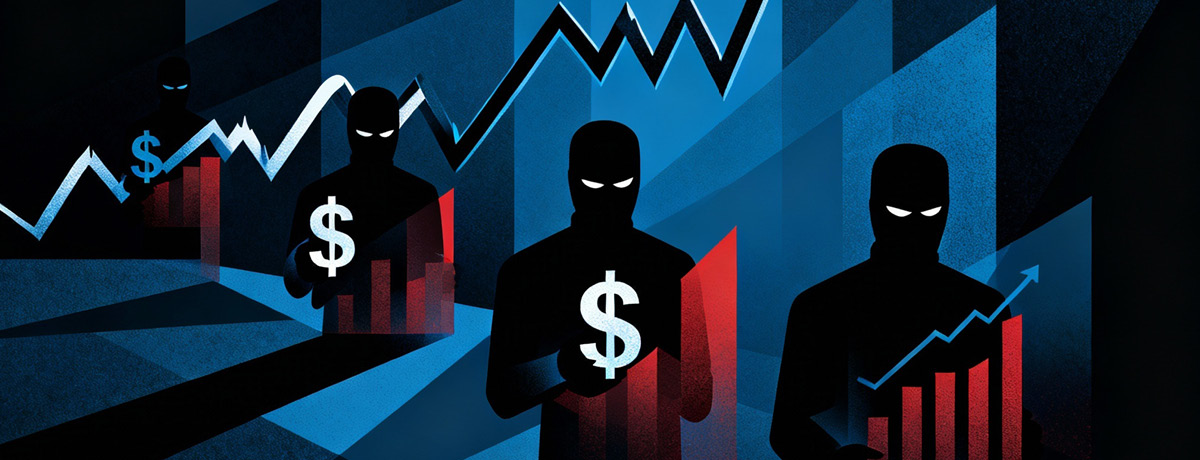

If Back to the Future’s Marty McFly time-travelled to 2026, he might be forgiven for thinking he’d never left Hill Valley, circa 1985. The oversized shoulder pad is experiencing a fashion renaissance, Michael Jackson’s Thriller has returned to the top five on the album chart and perhaps most ‘80s of all, a criminal law classic—insider trading—has moonwalked back into the headlines.
While they have yet to create the kind of media maelstrom that surrounded players like Michael Milken and Ivan Boesky during the Reagan era, the latest wave of insider trading scandals includes a massive multi-year scam that implicates Big Law attorneys and has been dubbed by The Wall Street Journal as one of the “most brazen insider trading schemes in years.”
Federal officials have also been under scrutiny for potentially scoring quick profits from their knowledge of upcoming government decisions. In keeping with the ‘80s theme, some predict that prosecutors may be forced to invoke the “Eddie Murphy Rule” in government-related cases—a moniker that refers to the insider trading plot at the center of Murphy’s 1983 film Trading Places.
The modern plot twist in all of this ‘80s-style action? Rising concerns about the role of technology and the fast-growing prediction markets, which may make it easier and more tempting for bad actors to turn insider information into illicit profits.
‘Making It Rain’
On May 6, 2026, the U.S. Department of Justice unsealed criminal charges against 30 people, including corporate attorneys and financial professionals who were alleged to have stolen and used confidential information on more than two dozen merger and acquisition deals from several of the nation’s premier law firms.
According to a simultaneous civil complaint filed by the Securities and Exchange Commission, Nicolo Nourafchan, a Big Law corporate lawyer and Robert Yadgarov, a Long Island, N.Y.-based personal injury lawyer, are believed by prosecutors and regulators to have orchestrated the scheme.
The pair allegedly recruited other lawyers to provide tips about upcoming deals, which were then issued to stock traders in exchange for kickbacks on a portion of the trading profits. Citing court documents, The Wall Street Journal reported that participants “celebrated their windfalls—which ranged from $2,000 to $3 million—by exchanging memes of ‘making it rain’ dollar bills.”
Building the Network
One lawyer, Gabriel Gershowitz, was recruited by Nourafchan and Yadgarov in 2019. According to court documents, Gershowitz, who worked for Weil, Gotshal & Manges and Willkie Farr & Gallagher while the scheme progressed, is cooperating with prosecutors after secretly pleading guilty last year. Reuters reported that Avi Sutton, a former Wachtell, Lipton, Rosen & Katz lawyer who joined an investment bank in 2022, was also recruited and is referred to as an unindicted co-conspirator in the case.
‘Gimme the Scoop’
Nourafchan is alleged to have started the scheme in 2014, not long after he graduated from Yale Law School. He continued trading information, prosecutors said, while working for major law firms like Latham & Watkins, Sidley Austin and most recently, Goodwin Procter.
“Despite his Ivy League pedigree, Nourafchan was a midlevel deal lawyer who hopped among prestigious firms,” the Wall Street Journal wrote. “Goodwin terminated him in August 2023 after he hadn’t worked on a billable matter for months. His main reason for showing up at the office, according to court records and people familiar with the matter, was to sift through computer systems to uncover pending deals that he could sell to an ever-growing ring of traders in Florida, New York, Russia and Israel.”
The Roomba Connection
One of the deals Goodwin handled while Nourafchan was at the firm was Amazon’s failed 2022 attempt to acquire iRobot, maker of the Roomba vacuum. Prosecutors, in their indictment, said that while on leave from the firm, Nourafchan was not assigned to the deal. But he accessed Goodwin’s document management system and viewed confidential materials on the potential acquisition, nonetheless.
Prosecutors allege that Nourafchan then sent the information to one of the traders, who subsequently purchased iRobot securities. As the insider material filtered through the traders involved in the scheme, one of those seeking information messaged a co-conspirator, “Yo guy. Gimme the scoop. Gimme that crack.”
On June 1, Nourafchan, Yadgarov and 13 other defendants—including Nourafchan’s brother, an accountant—pleaded not guilty. They face multiple securities fraud- and money laundering-related counts. Nourafchan is also charged with two counts of obstruction of justice.
A 12-Year Sentence
This is not, of course, the first time in recent years that M&A lawyers have faced insider trading charges. In 2011, for instance, corporate attorney Matthew Kluger was sentenced to 12 years in prison for passing along confidential information on transactions to a professional stock trader. The sentence was a record for an insider trading case.
A Familiar Playbook
As in the case alleged against Nourafchan, the scheme involving Kluger was long-running and stretched across multiple law firms. Kluger had passed information to traders for 17 years, prosecutors said, beginning when he was still a newly minted associate at Cravath Swaine & Moore. He would continue as he transitioned to roles at Skadden, Arps, Slate, Meagher & Flom, Fried, Frank, Harris, Shriver & Jacobson, Sills Cummis & Gross and Wilson Sonsini Goodrich & Rosati.
While at the firms, Kluger regularly stole and disclosed nonpublic information regarding deals on which his firms were working. Overall, profits from his insider trading schemes netted conspirators as much as $32 million, according to media reports at the time.
Tracking the ‘AlphaRacoon’
As the case against Kluger shows, the allegations against Nourafchan and his co-defendants follow a relatively familiar pattern. Confidential information, gained in a sophisticated scheme developed over years, is used to help investors gain an advantage in securities trades.
The developing prediction markets are creating a whole new insider-trading scenario, however. The markets allow users to buy and sell contracts tied to future events and a user with insider information about an outcome is well-positioned to rapidly make outsized profits.
Betting on Insider Knowledge
Consider a recently filed case against Michele Spagnuolo, a Google employee who allegedly made a $1.2 million profit trading on the prediction market platform Polymarket on the basis of confidential business information, federal prosecutors say. Using the alias “AlphaRacoon” as his username, the Switzerland-based software engineer allegedly used his insider knowledge to place bets on the outcomes of Google’s most popular search results in 2025.
He now faces criminal charges of commodities fraud, wire fraud and money laundering, as well as a civil suit by the Commodity Futures Trading Commission (CFTC), which accuses him in court documents of misappropriating confidential material and “knowingly or recklessly using it to trade [on Google’s] Year in Search List…in breach of his duties of trust and confidentiality.”
The Ex-Congressman and Kalshi
And the cases keep coming. On June 3, 2026, various news outlets reported that ex-Rep. George Santos, a New York Republican expelled from Congress in 2023 and who served a four-month stint in federal prison before his sentence was commuted by President Trump, is facing an investigation for allegedly engaging in an insider trading scheme involving his appearance at Trump’s State of the Union address earlier this year.
Ahead of the speech, people were placing scores of bets on Kalshi, a prediction market, on who would attend. Santos said he was going. As Trump spoke, however, Santos posted online that he was stuck at the airport.
A Suspicious Wager
Santos allegedly had a Kalshi account and before telling the public that he would be unable to go to the State of the Union, placed bets that he would not attend. The move resulted in tens of thousands of dollars in profits, government sources told news media outlets. As a result, Kalshi flagged the trades, froze Santos’ account and referred the matter to the CFTC and the U.S. Department of Justice. One or both of the agencies is investigating the trades, according to various news sources.
Misusing Classified Information
A third recently filed case highlights the potential insider trading threat that occurs when government and military officials use classified information to profit on the prediction markets. Federal employees are prohibited from using confidential government information for personal financial gain. But recent trades on the prediction markets just ahead of government actions have made eye-popping profits for traders.
In April, Gannon Ken Van Dyke, while serving as a U.S. Army Special Forces master sergeant, was charged with allegedly using classified material to place bets on Polymarket related to the U.S. government’s capture of Venezuela President Nicolás Maduro. Van Dyke, who is facing civil and criminal penalties, scored more than $400,000 in profits from bets of $33,000, according to prosecutors.
Classified Bets
Not long before Van Dyke’s indictment, the White House warned staff in an internal email not to place bets on the prediction markets amid the war in Iran. The Wall Street Journal reported that the email came on March 24. The previous day, about 15 minutes before Trump made a major announcement on the conflict, “a mysterious flurry of activity kicked off in the futures markets,” the Journal reported. “More than $760 million worth of oil futures contracts changed hands in less than two minutes.”
The Eddie Murphy Rule
Prosecutors may not be able to rely on long-used legal tools to prosecute cases like the one against Van Dyke, however.
In a recent commentary for Westlaw Today, attorneys from Akin Gump Strauss Hauer & Feld noted a pair of recent decisions at the U.S. Court of Appeals for the Second Circuit that may curtail prosecutors’ ability to charge defendants with wire fraud, which is the “most effective charge for insider trading involving prediction markets.” They suggested that as a result, the government may need to rely on seldom-used provisions of the Commodity Exchange Act (CEA).
Trading Places, Revisited
The most notable among those provisions is the so-called "Eddie Murphy Rule," which, according to the lawyers, “prohibits the theft of government information for use in trading derivatives, to pursue insider trading in prediction markets based on government information.” In Murphy’s movie Trading Places, characters scheme to steal “a confidential government report on orange crop forecasts for the purpose of trading frozen concentrated orange juice futures,” the lawyers noted.
In its recent cases, the Second Circuit found that private information may qualify for wire fraud charges, but “only if the owner can demonstrate that maintaining its confidentiality has economic value,” the Akin Gump lawyers wrote. Government information, like that in the Van Dyke case, “may lack commercial value,” they said and thus, “may constrain the government's ability to pursue those facts under a wire fraud theory.”
“The Commodity Exchange Act, in contrast, may offer a more flexible framework for addressing insider trading in prediction markets,” they said. “The key distinction lies in the statutory language.”
---
David L. Brown is a legal affairs writer and consultant, who has served as head of editorial at ALM Media, editor-in-chief of The National Law Journal and Legal Times and executive editor of The American Lawyer. He consults on thought leadership strategy and creates in-depth content for legal industry clients and works closely with Best Law Firms® as senior content consultant.